20.3 MUTUAL INDUCTANCE AND SELF-INDUCTANCE
This section explores two related electromagnetic phenomena: self-induction, where a coil induces an electromotive force (emf) in itself, and mutual induction, where a changing current in one coil induces an emf in a nearby coil.
Key Concepts
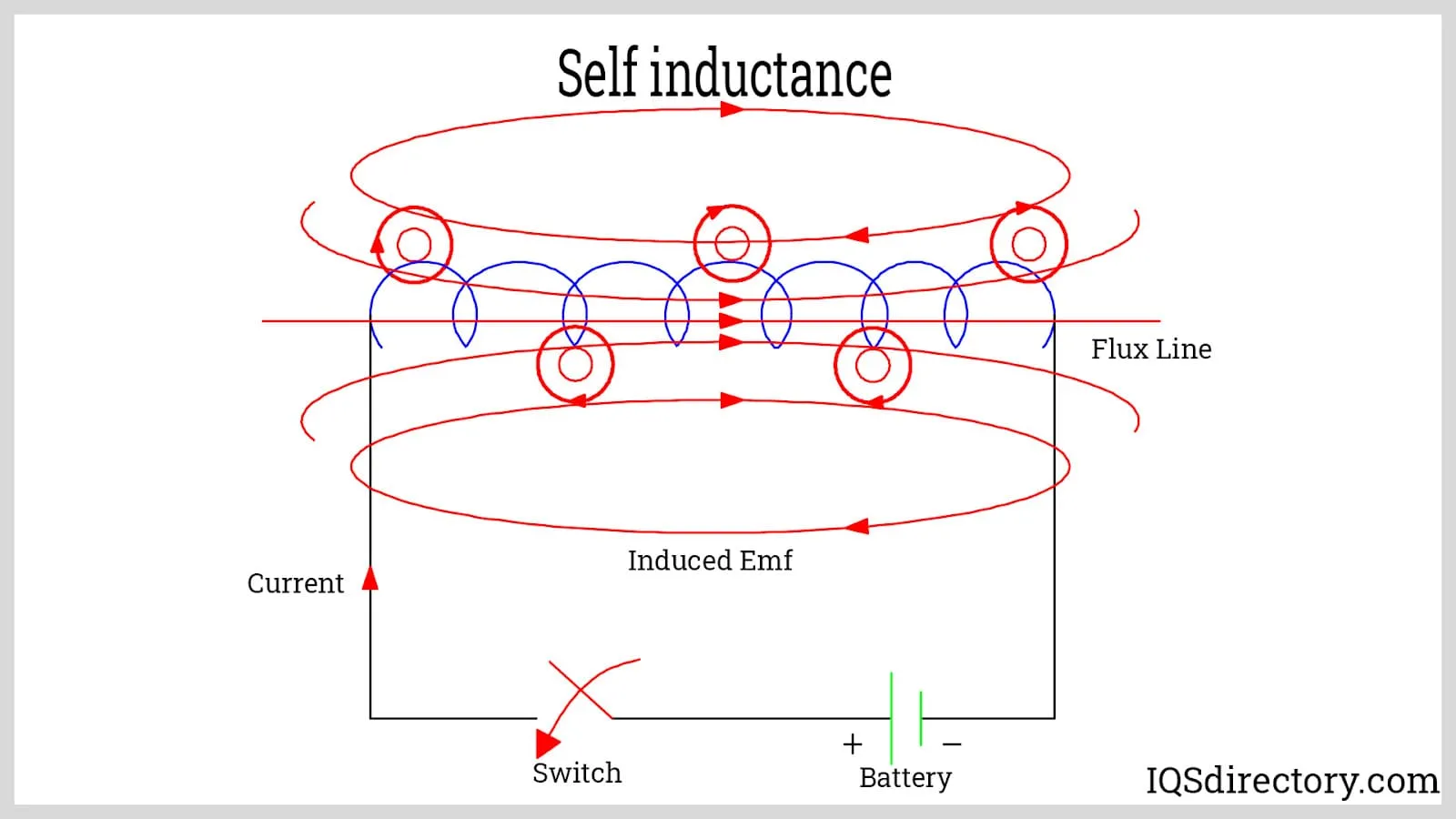
Self-Induction
- Definition: The phenomenon in which a changing current in a coil induces an electromotive force (emf) in the coil itself.
- Mechanism: A change in current (ΔI) within a coil over a time interval (Δt) causes a change in the magnetic field and thus a change in magnetic flux through the coil. This changing flux induces an opposing emf (εL) in the same coil.
- Back EMF: The self-induced emf is often called "back emf" because, according to Lenz's law, it always opposes the change in current that created it.
- Inductors: Coils designed to have a specific self-inductance are called inductors or chokes. They are fundamental components in AC circuits, where they function similarly to resistors in controlling current.
Figure 20.9 (a): Self-induction in a coil connected to a battery and rheostat.
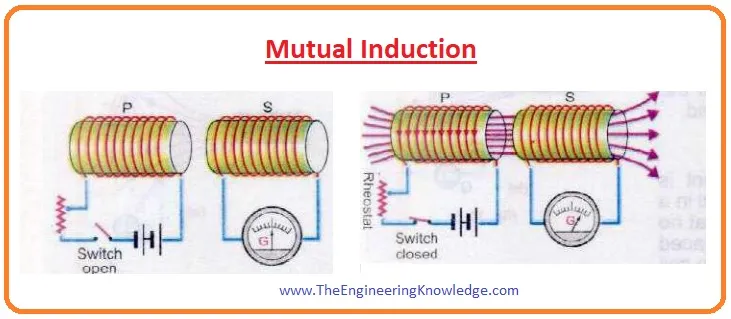
Mutual Induction
- Definition: The phenomenon in which a changing current in one coil (the primary coil) induces an emf in a neighboring coil (the secondary coil).
- Mechanism: When an alternating or changing current flows through the primary coil, it produces a changing magnetic flux. If a secondary coil is placed nearby, this changing flux links with it, inducing an emf in the secondary coil.
- The induced emf in the secondary coil (ε2) is proportional to the rate of change of current in the primary coil (ΔI1/Δt).
Figure 20.9 (b): Mutual induction between two coils.
Summary
- Self-Induction: A changing current in a coil induces an opposing emf in the same coil. This property is quantified by self-inductance (L).
- Mutual Induction: A changing current in one coil induces an emf in a nearby coil. This is quantified by mutual inductance (M).
- Lenz's Law: In both cases, the negative sign in the formulas signifies that the induced emf opposes the change that causes it.
- Inductors: Components that utilize self-inductance are called inductors and are crucial in AC circuits.
- Unit: The SI unit for both self-inductance and mutual inductance is the henry (H).
Real-World Application: Inductance is a fundamental principle behind transformers, electric motors, generators, and various electronic filters and oscillators.
References
(Derived from FBISE textbook)