Filtering
The process of converting Alternating Current (AC) to Direct Current (DC) involves two main stages: rectification and filtering. Rectification converts the AC signal, which periodically reverses direction, into a pulsating DC signal that flows in only one direction. Filtering then smooths this pulsating DC to produce a more constant voltage level suitable for powering electronic devices.
Key Concepts
Full Wave Rectification
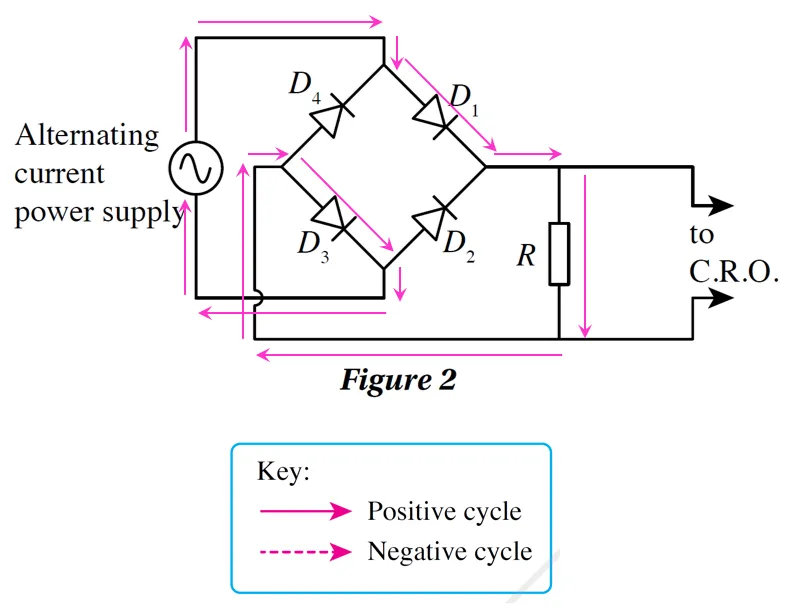
In full-wave rectification, the entire AC input waveform (both positive and negative half-cycles) is converted into a pulsating DC output. A common method to achieve this is by using a full-wave bridge rectifier.
- Circuit Components: The circuit uses four diodes (D1,D2,D3,D4) arranged in a bridge configuration, connected to an AC source and a load resistor (R).
*Figure 20.6: (a) Full wave bridge rectifier circuit.
-
Working Principle:
-
During the Positive Half-Cycle:
- End A of the secondary coil is positive and end B is negative.
- Diodes D1 and D2 become forward-biased and conduct electricity.
- Diodes D and become and do not conduct.
Filtering
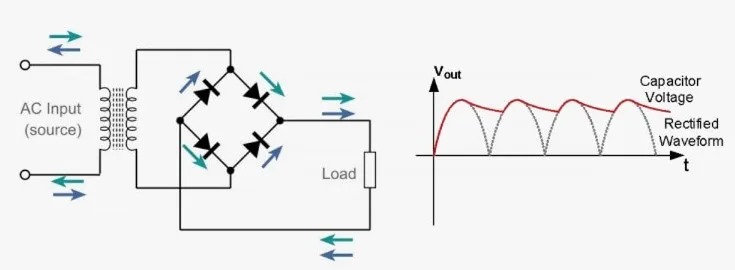
Filtering is the process of smoothing the pulsating DC output from a rectifier to produce a more stable, constant DC voltage. This is typically achieved by connecting a capacitor in parallel with the load resistor.
Figure 20.8: (a) Full-wave rectifier with a filter capacitor. (b) Smoothing action of the capacitor.
Summary
- Full-Wave Rectification converts both the positive and negative half-cycles of an AC input into a pulsating DC output.
- A Bridge Rectifier, using four diodes, is a common full-wave rectifier circuit. Pairs of diodes conduct alternately for each half-cycle, ensuring current flows through the load in a single direction.
- Filtering is the process of smoothing the pulsating DC output of a rectifier.
- A capacitor connected in parallel with the load is used as a simple filter. It charges to the peak voltage and discharges slowly to maintain the output voltage level, reducing fluctuations.
- The effectiveness of the filter depends on the capacitance value and the load resistance.
This combination of rectification and filtering is fundamental to power supply design, converting household AC power into the stable DC power required by most electronic devices.
References
(Derived from FBISE textbook)