20.1 ALTERNATING CURRENT AND VOLTAGE
This section introduces alternating current (AC) and voltage, defining their sinusoidal nature and key terminologies such as peak value, RMS value, frequency, and period. It also covers the calculation of power in AC circuits with resistive loads.
Key Concepts
An AC generator produces an alternating current or voltage that varies sinusoidally with time.
Sinusoidal Waveform
The general form for an alternating quantity (current or voltage) is:
x=x0sin(ωt)
where:
- x is the instantaneous value at time t.
- x0 is the maximum or peak value.
- ω is the angular frequency of the generator.
Specifically for current and voltage:
- Alternating current: I=I0sin(ωt)
- Alternating voltage: V=V0
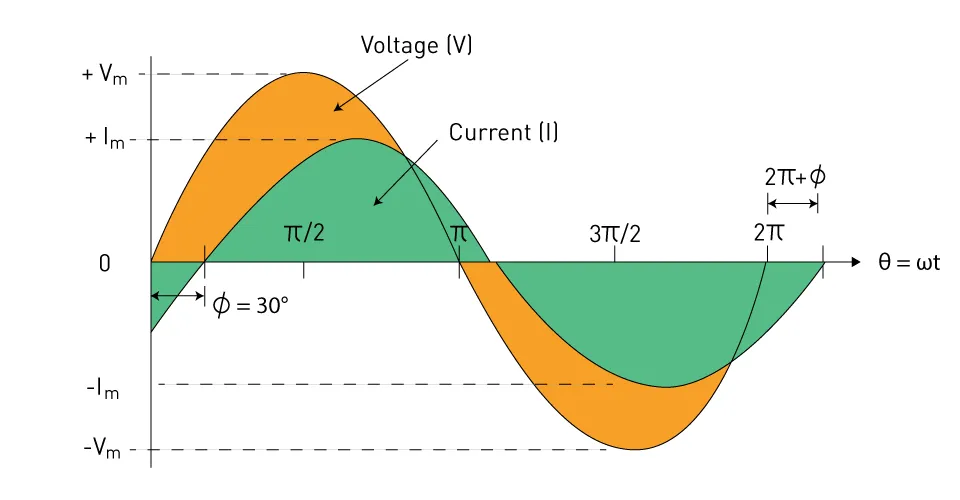
A sinusoidal waveform, as shown in the graph, has the following characteristics:
- It changes direction (polarity) at regular intervals.
- Its magnitude changes continuously.
- The change is smooth, being most rapid at the zero-crossing points and slowest at the peaks.
Figure 20.1: Sinusoidal wave form of AC voltage or current.
AC Terminologies
- Cycle: One complete set of positive and negative values of an alternating quantity.
- Time Period (T): The time taken to complete one cycle.
- Frequency (f): The number of cycles completed in one second, measured in Hertz (Hz). In Pakistan, the standard AC frequency is 50 Hz.
- Peak Value (x0): The maximum value (positive or negative) of the alternating quantity.
- Average Value: The average of all values over a period. For a sinusoidal waveform over one complete cycle, the average value is zero because the positive and negative halves cancel each other out.
Average value=Time T
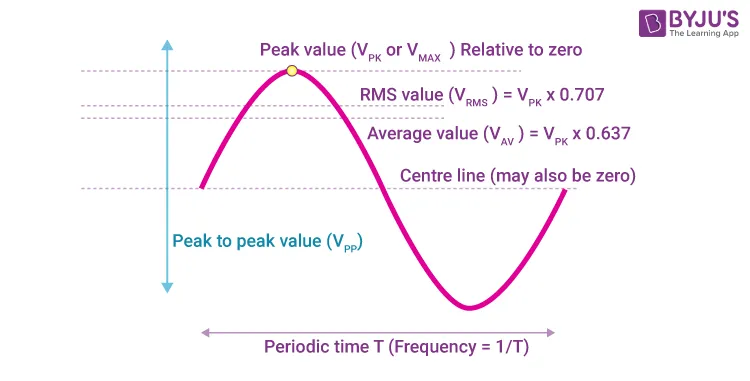
Figure 20.2: Relationship between r.m.s and peak values.
The relationship between r.m.s. and peak values is:
Mean Power and Maximum Power
When an alternating current I=I0sin(ωt) flows through a resistor R, the instantaneous power dissipated is:
Since the current is squared, the power is always positive. The value of varies between 0 and 1, with an average value of . Therefore, the average (or mean) power delivered to the resistor is:
This shows that the mean power in a resistive load is half the maximum power ().
Possible Questions/Answer
-
Q: An AC circuit consists of a pure resistance of 20Ω and is connected across an AC supply of 220 V,50 Hz. Calculate (a) the peak value of voltage, (b) the peak value of current, and (c) the equations for voltage and current.
A:
- Given: R=20Ω, V, .
Summary
- Alternating current (AC) and voltage vary sinusoidally with time, described by equations like V=V0sin(ωt).
- Key properties include peak value (V0), period (T), frequency (f), and angular frequency ().
Significance: Understanding AC is fundamental to modern electrical systems, as most power generation and distribution is done using AC. The r.m.s. value is particularly important for specifying voltages (e.g., household 220 V is an r.m.s. value) and for power calculations.
References
(Derived from FBISE textbook)