Save your progress and unlock personalized insights.
Work | Physics 11 Notes | Notely
Physics 11·Work And Kinetic Energy
Work
Not started
Finding lessons...
Work Done by a Constant and Variable Force
Introduction
In physics, work is a measure of energy transfer that occurs when an object is moved over a distance by an external force. It is a crucial concept for understanding how energy is used and transformed in mechanical systems. The calculation of work depends on whether the force applied is constant or variable.
1. Work Done by a Constant Force
Definition
Work is done by a constant force when the force applied to an object does not change in magnitude or direction, and the object undergoes a displacement.
Formula:
The work done (W) is defined as the product of the magnitude of the displacement (d) and the component of the force (F) that is parallel to the displacement. W=(Fcosθ)d
This is more commonly written as the dot product of the force and displacement vectors: W=F⋅d=Fdcosθ
Where:
F is the magnitude of the constant force.
d is the magnitude of the displacement.
θ is the angle between the force vector and the displacement vector.
Key Characteristics
Scalar Quantity: Work is a scalar quantity, meaning it has magnitude but no direction. It can be positive, negative, or zero.
Unit: The SI unit of work is the Joule (J). One joule is the work done when a force of one newton displaces an object by one meter in the direction of the force (1 J = 1 N·m).
Dimensions: The dimensional formula for work is [ML²T⁻²].
Conditions for Work Done
The value and sign of the work done depend on the angle θ:
Positive Work (θ<90∘): Work is positive when the force (or a component of it) is in the same direction as the displacement. This means the force is helping the motion. Maximum positive work is done when θ=0∘ (W=F).
2. Work Done by a Variable Force
Definition
In many real-world scenarios, the force applied to an object is not constant; it changes as the object moves. Examples include the force exerted by a spring, which increases as it is stretched, or the force of a rocket engine, which changes as fuel is consumed.
Calculation Methods
To calculate the work done by a variable force, we cannot simply multiply the force by the distance. Instead, we must account for the changing force.
a) Graphical Method
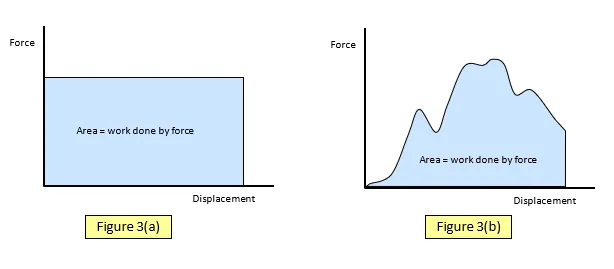
The work done by a variable force can be found graphically by calculating the area under a Force vs. Displacement graph.
Procedure: Plot the component of the force parallel to the displacement (Fcosθ) on the y-axis and the displacement (d) on the x-axis.
Result: The area of the region between the curve and the x-axis gives the total work done.
b) Interval Method (Calculus)
For a more precise calculation, we can use calculus.
Procedure:
Divide the total displacement into a large number of infinitesimally small intervals, Δd.
Over each tiny interval, the force can be considered approximately constant. The small amount of work done, ΔW, in this interval is ΔW=FΔdcosθ.
The total work done is the sum of the work done in all these small intervals.
Result (Integral Form): As the intervals become infinitesimally small, this sum becomes an integral. The total work done in moving from an initial position to a final position is:
Possible Questions/Answer
Q: What is the difference between the scientific and everyday definitions of "work"? A: In everyday language, "work" can refer to any mental or physical effort. In physics, work is only done when a force causes a displacement. Holding a heavy object stationary for a long time may feel like work, but in the physics sense, no work is done on the object because there is no displacement.
Q: Can work be done by a centripetal force? A: No. A centripetal force is always directed perpendicular to the direction of motion (the velocity) of an object in uniform circular motion. Since the angle θ is 90°, the work done by the centripetal force is always zero (W=Fdcos(90∘)=0).
Summary
Work is the energy transferred to or from an object by a force acting over a displacement.
For a constant force, work is calculated as W=Fdcosθ.
For a variable force, work is the area under the Force-Displacement graph or is found by integration.
Work is a scalar quantity measured in Joules (J) and can be positive, negative, or zero.
Zero Work (θ=90∘): No work is done when the force is perpendicular to the displacement. For example, the gravitational force does no work on a satellite in a perfectly circular orbit because the force is always perpendicular to the satellite's instantaneous velocity.
Negative Work (θ>90∘): Work is negative when the force (or a component of it) opposes the direction of displacement. This means the force is hindering the motion. For example, the work done by friction is always negative. Maximum negative work is done when θ=180∘ (W=−Fd).