Not started
Finding lessons...
Introduction
In physics, potential energy is the energy an object possesses due to its position in a force field. For objects near the Earth's surface, the simple formula P.E.=mgh is a useful approximation. However, for objects at large distances, such as satellites, a more general definition is needed. Absolute Gravitational Potential Energy provides this framework by defining the potential energy of a mass at any point in a gravitational field relative to a universal zero point.
The absolute potential energy of a body at a point in a gravitational field is defined as the work done by the gravitational force in moving the body from that point to a position of zero potential.
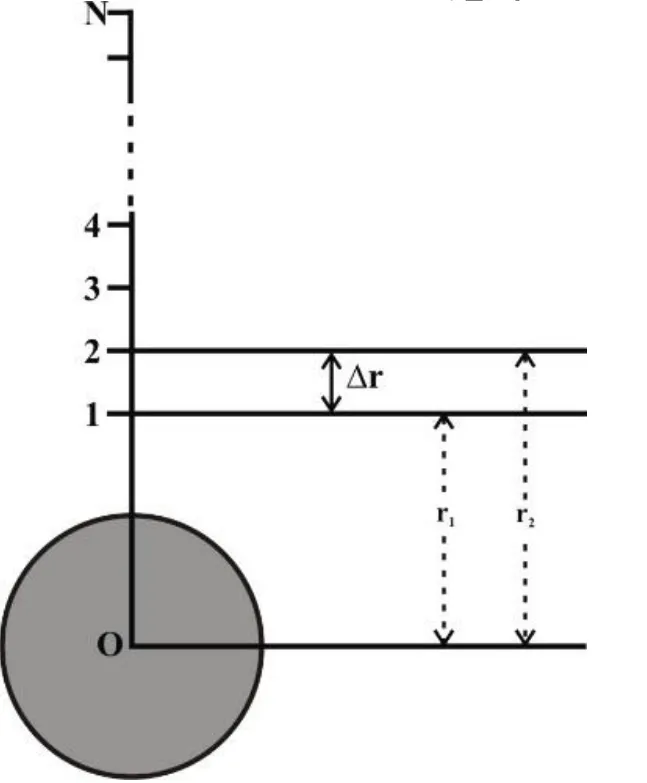
To find the absolute potential energy at a point, we calculate the total work done by the gravitational force when moving a mass m from an initial point r1 to a final point at infinity. The path is divided into a large number of very small intervals.
Step 1: Work Done Over a Small Interval
Let's calculate the work done, W1→2, as the mass moves a small distance from r1 to r2. The change in distance is . The gravitational force is not constant over this interval, so we use an average position for the force calculation.
Through a clever approximation for a very small interval, it can be shown that the average value of is approximately . The work done by the gravitational force (which points inward) over the outward displacement is:
Using the approximation :
Separating the terms gives:
Step 2: Total Work Done
The total work done (Wt) in moving the mass from r1 to a distant point rn is the sum of the work done in all the small intervals.
This is a "telescoping sum" where all intermediate terms cancel out, leaving only the first and last terms:
Step 3: Moving the Mass to Infinity
To find the absolute potential energy, the final destination is infinity, so we let rn→∞. As rn becomes infinitely large, the term approaches zero.
This work done is the absolute potential energy. Replacing with a general distance , we get the final formula.
Final Formula for Absolute Potential Energy (Ug):
Ug(r)=−r
Q: Why is gravitational potential energy always negative?
A: It is negative because of the choice of the zero reference point at infinity. Since gravity is an attractive force, the system loses potential energy as two masses are brought closer together from an infinite separation. To move them from a distance r back to infinity, external work must be done on the system, which increases its potential energy up to a maximum of zero.
Q: How does the formula P.E.=mgh relate to the absolute potential energy formula?
A: The formula mgh is an approximation that is valid only for small changes in height h near the Earth's surface, where the gravitational field g can be considered constant. It calculates the change in potential energy relative to a local zero point, not the absolute potential energy relative to infinity.
| Concept | Formula |
|---|---|
| Absolute Gravitational Potential Energy | Ug=−rGMm |